image image image image image image image
Setareh Story
PACI poem
Parsis' Story
Sam's Story
Mona's Story
Hamid's Story
Peyman:Lymphoma Patient
Hi, I am Setareh, 28 yrs old, a dentist in my 2nd yr of Maxillofacial residency. I have been diagnosed with an aggressive form of Acute Leukemia (AML) and I'm being treated at MD Anderson cancer center.
I am not identified by my cancer.

I am not just another patient.

I am a soldier.

I am a survivor.

I am a human.
"My name is Parsis and I’m 2 ½ years old. I love my maman and baba very much, because they kiss me all the time and say I’m their Persian Princess. I hate it when I go to get blood…my mommy says it is good for me; but it hurts"
Hi. My name is Sam Mirchi. My only chance of surviving this killer disease is the stem cells from the matching blood donor.  That one special person could be you.  You could save my life, help me be there for my family. Please be my hero for life.  
" I am writing to you from the Intensive Care Unit (ICU) at Jackson Memorial Hospital, in Miami, Florida. Unfortunately after only four months living in America, in November 2007, I was diagnosed with a rare blood disorder, which has gradually led to bone marrow failure.
"I have Leukemia (AML) and looking for a bone marrow donor. I have a 12 years old daughter whom I love very much.
"I am 36 years old. In 2008, I was diagnosed with Hodgkin's Lymphoma. Three months after an 8 months round of chemo and radiation, the disease came back and spread through my bones."
.

watch_more_videos

Welcome to PACI - Read Our Latest News


GREAT NEWS!

PACI is very delighted to announce that Kia Bowman, who was diagnosed with Large Diffuse B-Cell Lymphoma and had been patiently waiting for a marrow transplant, found her match! The marrow transplant was a huge success! With the help of all of you who assisted us through the process, Kia will continue to live her life happily in the company of her loving family and friends.


4th Annual Seminar Outline

Seminar

On October 9th, 2011, PACI held its 4th Annual Cancer Awareness Seminar at the Skirball Cultural Center . The seminar was mainly aimed at the Persian American community. Leading physicians, each in their own field of expertise, presented the most enlightening, informative, and practical advice on thyroid cancer (Dr. Armando Guiliano), breast cancer (Dr. Homayoon Sanati) and hematology (Dr. Sepehr Rokhsar). The importance of proper nutrition in prevention of cancer was highly emphasized by Professor Parviz Ghadirian. Nowadays, prevention, early detection, treatment, and healthy nutrition increase cancer survivor rates.

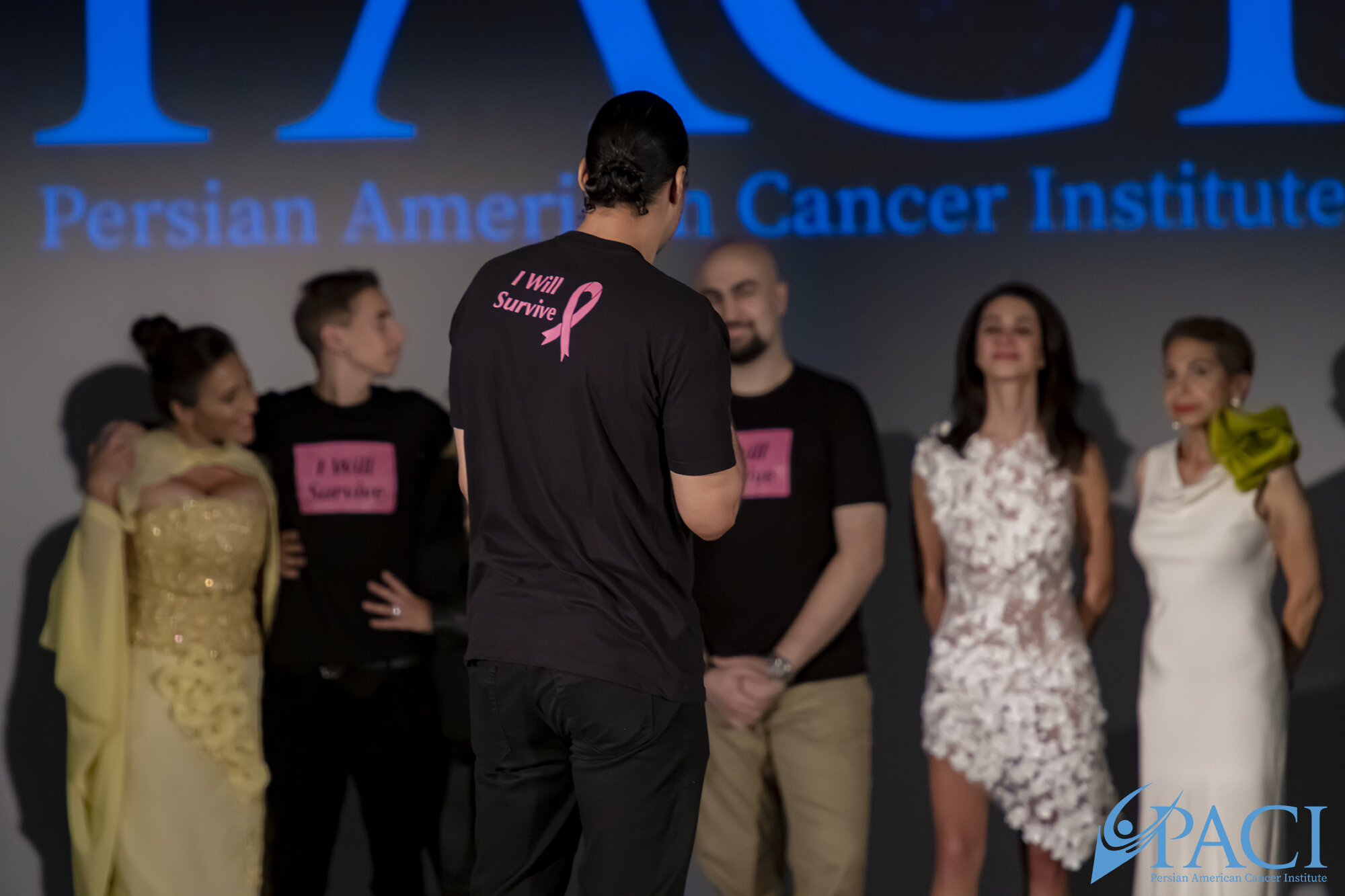
The event was an absolute success with a full house. The audience was particularly touched when Mrs. Sadler, the PACI chair founder and a cancer survivor herself, asked all the fellow cancer survivors to the stage. They all received a standing ovation; and the audience was moved by so many radiantly beautiful and gracious survivors.

Mr. John Paley, General Manager of 670AM KIRN Radio Iran, a cancer survivor himself, presented a $12,000 check on behalf of PACI to Be The Match, the National Marrow Donor Program. The funds donated were raised through the generous contribution of the general public, which pay for the marrow test kits, in registering possible donors who help save lives.  The audience had an amazing afternoon filled with education and entertainment. The latter of which was by an outstanding live performance by the talented Arash Avin.
   

Dr. Silvana Martino News

Good News! PACI is proud to share articles written by one of our board members,

Dr. Silvana Martino:

Breast Cancer Advisor, Dec. 2011

Breast Cancer Advisor, Jan. 2012

Martino_pic

Dr. Silvana Martino D. O., FACOI is the Director of Breast Cancer Research and Education for The Angeles Clinic Foundation. She is board certified in internal medicine and medical oncology. Dr. Martino has specialized in the treatment and research of breast cancer for over three decades. She is a nationally recognized leader in the field of breast cancer. Her body of work has included research in breast cancer prevention, early breast cancer and metastatic disease. Dr. Martino has conducted and coordinated large national and international studies which have resulted in changing the standard of care worldwide.

We've been writing for YOU.

The Angeles Clinic Foundation is proud to release the first issue of the Breast Cancer Advisor by Dr. Silvana Martino. We're asking you to read it and to please send feedback to This e-mail address is being protected from spambots. You need JavaScript enabled to view it !


Biology Basics

In this issue, I want to give you a historical perspective on how our understanding of the spread of breast cancer has changed and the impact that this has had on how we treat it. It was originally believed that breast cancer started in the breast. Once the breast was filled by it, it then would move into the neighboring lymph nodes. After they were occupied, the cancer would then spill into the blood system and from there to other parts of the body. (Full Article)


What's New?

Approximately 15 to 20 percent of breast cancers are HER2/neu positive. These cancers tend to be a bit more aggressive. The recognition of the HER2/neu receptor resulted in a major advance. Once it was identified, we were able to search for drugs that specifically targeted this receptor. The drug Herceptin was the first of these therapies. Its first use was in advanced disease where Herceptin was found to be of benefit both when given alone and also when combined with other therapies. The next step was to see if this drug was also of benefit in early breast cancer. (Full Article)


Guest Writter


Arnold L. Vinstein, MD "Imaging to Screen Women for Breast Cancer"
Although the controversy as to the appropriate interval and age for screening women with mammography continues in the press, the longstanding position of the American Cancer Society, the American College of Surgeons and the Society for Breast Imaging is that women of average risk begin annual screening mammography at age 40. The use of other screening tests, such as breast thermography and ultrasound, is more controversial primarily due to the excessive number of false positive results (a finding that suggests an abnorabnormality is present but is benign on further testing). (Full Article)


Thank You for Oct. 9th, 2011

Oct_9_Thank_You_copy
   

Page 1 of 3